
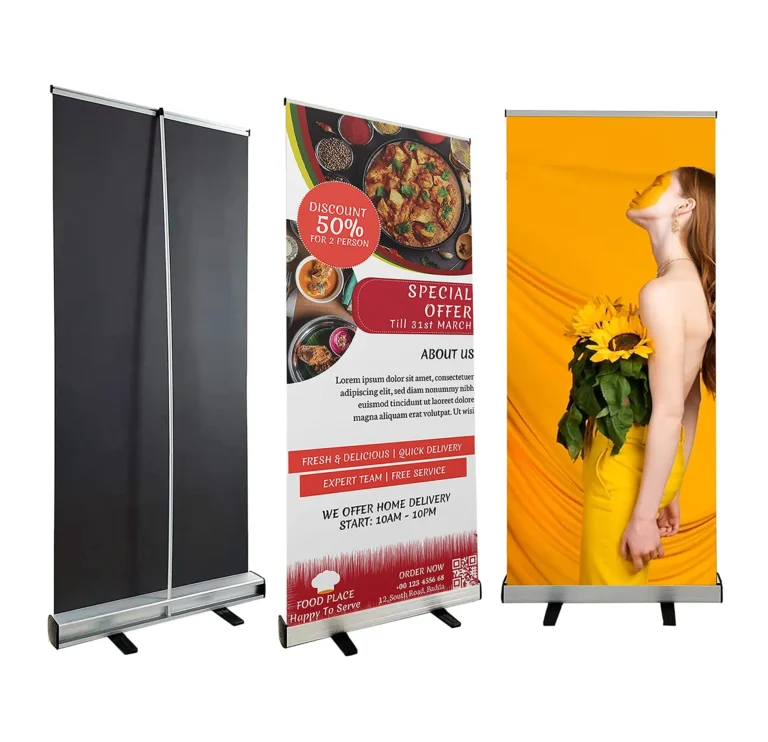
Custom Roll Up Banners offer portable, professional branding that grabs attention within seconds at events, conferences, and retail displays. In crowded venues, these retractable displays provide a crisp, consistent message from booth to booth, combining easy setup with durable construction. This guide focuses on roll up banners sizes, roll up banner materials, custom banner pricing, and printed roll up banners, helping you pick a solution that fits your space, audience, and budget. Whether you’re preparing for a trade show, product launch, or on-site promotion, a well-chosen banner can boost visibility without adding logistical headaches. By weighing dimensions, materials, and total cost of ownership, you can select a banner that preserves brand integrity and maximizes return on investment across events.
Viewed through an alternative lens, these retractable displays—often called pull-up banners, banner stands, or portable signage—offer the same impact with a different naming convention. In practice, you’ll evaluate print quality, stand durability, and how easily graphics can be swapped to reflect new campaigns, ensuring consistent messaging across venues. Think of them as compact, modular visual tools that adapt to various spaces while still reinforcing brand identity.
Frequently Asked Questions
What roll up banners sizes are available for Custom Roll Up Banners, and how do I choose the right footprint?
Roll up banners sizes typically include widths around 800–850 mm for compact spaces and about 1000 mm for greater impact, with heights ranging from 2000 to 2380 mm. The best footprint depends on booth space, message length, and viewing distance. Consider double-sided configurations for higher visibility, and if outdoors, a taller model may improve readability. Always measure your space and verify the exact width and height options offered by your supplier to ensure legibility at a glance.
What materials are used for Custom Roll Up Banners and how do they affect durability and appearance?
Custom Roll Up Banners typically use vinyl or fabric mounted on a retractable aluminum stand. Vinyl offers durability, vibrant color, and cost-effectiveness, performing well indoors and for occasional outdoor use. Fabric banners deliver a premium look with sharp imagery and reduced glare, ideal for premium branding and longer campaigns. Finishes, edge treatments, and coatings can also influence durability and appearance—request proofs to verify color accuracy and alignment.
Why is print quality important for printed roll up banners, and what should I check when ordering Custom Roll Up Banners?
Printing quality directly affects readability and perceived value. Aim for a resolution of 720–1200 dpi at typical viewing distances. Request proofs at the intended print size, verify ICC color profiles to match brand colors, and review color test strips or sample panels to confirm legibility and contrast before approving a large order.
What factors drive custom banner pricing for Custom Roll Up Banners?
Pricing is influenced by size and orientation, material type (vinyl vs fabric), print quality and finish, hardware quality, and any customization (dual-sided banners, interchangeable graphics, carry cases). Lead times and vendor reliability also affect cost. Planning ahead can help secure bulk pricing or loyalty discounts while avoiding rush surcharges.
Are Custom Roll Up Banners suitable for outdoor use, and what options improve outdoor performance?
Most roll up banners are optimized for indoor use. For outdoor applications, look for weather-resistant coatings, wind-stable bases, and products rated for outdoor use. Taller heights and dual-sided designs can improve visibility in bright or windy venues. Always confirm outdoor suitability with the supplier and consider easily replaceable graphics if you anticipate frequent rebranding.
What maintenance tips help extend the life of Custom Roll Up Banners?
Store banners in their protective bag when not in use and keep them away from sharp objects. For vinyl banners, wipe with a soft cloth and mild cleaner; for fabric banners, use a gentle brush or lint roller to remove dust. Check graphic alignment and ensure the pull mechanism operates smoothly between uses. If you refresh branding often, consider modular systems that allow graphic swaps without replacing the entire unit.
| Topic | Key Points |
|---|---|
| Sizes | – Standard widths around 800–850 mm; ~1000 mm for more impact.n- Heights typically 2000–2380 mm.n- Choose based on booth space, message length, and viewing distance.n- Consider double-sided or multi-banner configurations for visibility.n- For outdoor or bright venues, taller heights may improve readability.n- Measure space and verify exact dimensions with supplier.n- Align sizes with signage strategy to keep messages legible at a glance. |
| Materials | – Vinyl: durable, vibrant, cost-effective; good for high resolutions and moderate humidity.n- Fabric: sharp imagery, premium feel; dye-sub or direct pigment printing; softer textures and reduced glare.n- Both require consideration of substrates, edge finishes, coatings, and sustainability options.n- Request proofs or samples to assess color accuracy and finish; color management helps translation from screen to print. |
| Printing options and image quality | – Resolution guidance: 720–1200 dpi for sharp text/images at typical viewing distances.n- Request proofs at intended print size to verify legibility.n- Use ICC color profiles and color test strips when possible to match brand guidelines. |
| Pricing | – Factors: size/orientation, material type, print quality/finish, hardware quality.n- Customization/extras: dual-sided banners, interchangeable graphics, carrying cases, anti-scratch protections.n- Lead times and vendor reliability can affect cost; plan ahead to avoid rush surcharges. |
| Durability and reuse | – Indoor use is the default; fabric often resists creasing and provides premium aesthetics.n- Outdoor use requires weather resistance and sturdier bases; verify outdoor ratings and replacement graphics.n- Reuseability depends on maintenance and ability to refresh graphics. |
| Use cases and strategic value | – Trade shows: quick branding in booth corners; retail: guide toward promotions; conferences: reinforce messaging.n- Compact, lightweight design enables easy transport between venues; cost-effective asset in the marketing mix. |
| Choosing the right Custom Roll Up Banner | – Start with objective: high impact from distance may favor larger widths and bold typography.n- Fabric banners offer premium branding for product photography and color depth.n- For frequent rebranding, choose modular systems that allow easy graphic refreshes. |
| Maintenance and care | – Store in protective bag; avoid sharp objects.n- Vinyl: wipe with soft cloth and mild cleaner; fabric: gentle brushing or lint roller.n- Recheck graphic alignment and pull mechanism when used across different setups. |
| Buying guidance | – Ask about warranty terms, replacement graphics, and turnaround times.n- Compare quotes for banner + stand; request proofs.n- Consider bulk pricing or loyalty programs for multi-event campaigns; confirm sustainability options. |
Summary
Conclusion